FOOD & CULTURE
Why chai means more than tea in Pakistan
Doodh patti, the visitor’s cup, roadside tea stalls and the pink, green and salted teas of the north: how one word covers so much of daily life.
What “chai” usually means
Ask for chai almost anywhere in Pakistan and you will be handed black tea cooked with milk and sugar, not tea leaves steeped in a cup with milk added afterwards. The most familiar version is doodh patti, which translates as “milk leaf”: the leaves are boiled directly in milk, with little or no water, until the colour turns a deep tan. Many households make a lighter version by boiling the leaves in water first and adding milk afterwards, and both are simply called chai. Boiling pulls more colour and bitterness out of the leaf than steeping does, which is why the drink is usually sweetened in the pot and why people raised on it often find a teabag in hot water thin by comparison.
A drink the country imports
Tea is so ordinary in Pakistan that it is easy to forget almost none of it is grown there. Small plantations exist around Shinkiari in Mansehra district, where a national tea research station has worked on local cultivation, but the overwhelming majority of what the country drinks is imported, much of it black tea from East Africa, and Pakistan is regularly listed among the largest tea importers in the world. Daily tea-drinking across the region is also younger than it feels. Historians generally trace the habit of drinking tea at home, rather than as an occasional luxury, to the first half of the twentieth century, when tea producers in British India ran sustained campaigns to sell tea to local consumers.
One word, two trade routes
The word itself carries a piece of that history. Most of the world’s words for tea come from two pronunciations of the same Chinese character. Languages that met tea over land, through Central Asia and Persia, tend to use a version of “cha”, which is where Urdu, Punjabi and Pashto get chai. Languages that met it by sea through Dutch traders in Fujian tend to use a version of “te”, which is where English gets tea. So when English speakers talk about “chai tea” they are, quite literally, saying tea twice.
The visitor’s cup and the office tray
In everyday life, chai is less a drink than a gesture. Offering tea to someone who walks through the door, whether a relative, a neighbour or the person who has come to fix the fridge, is one of the most widely shared courtesies in Pakistani homes, and turning it down usually takes some polite insisting. Offices run on it too: in many workplaces a tea boy or a nearby stall sends round trays of cups at fixed times of day. On the street, chai is sold from dhabas, roadside stalls and the small tea cafés that Karachi residents call Quetta hotels, many of them run by families from Balochistan and Khyber Pakhtunkhwa, where people sit for an hour over a cup that costs very little. Even the phrase “chai-pani”, tea and water, has stretched to mean refreshments in general, and, more cynically, a small tip expected for getting something done.
Not one chai: pink, green and salted
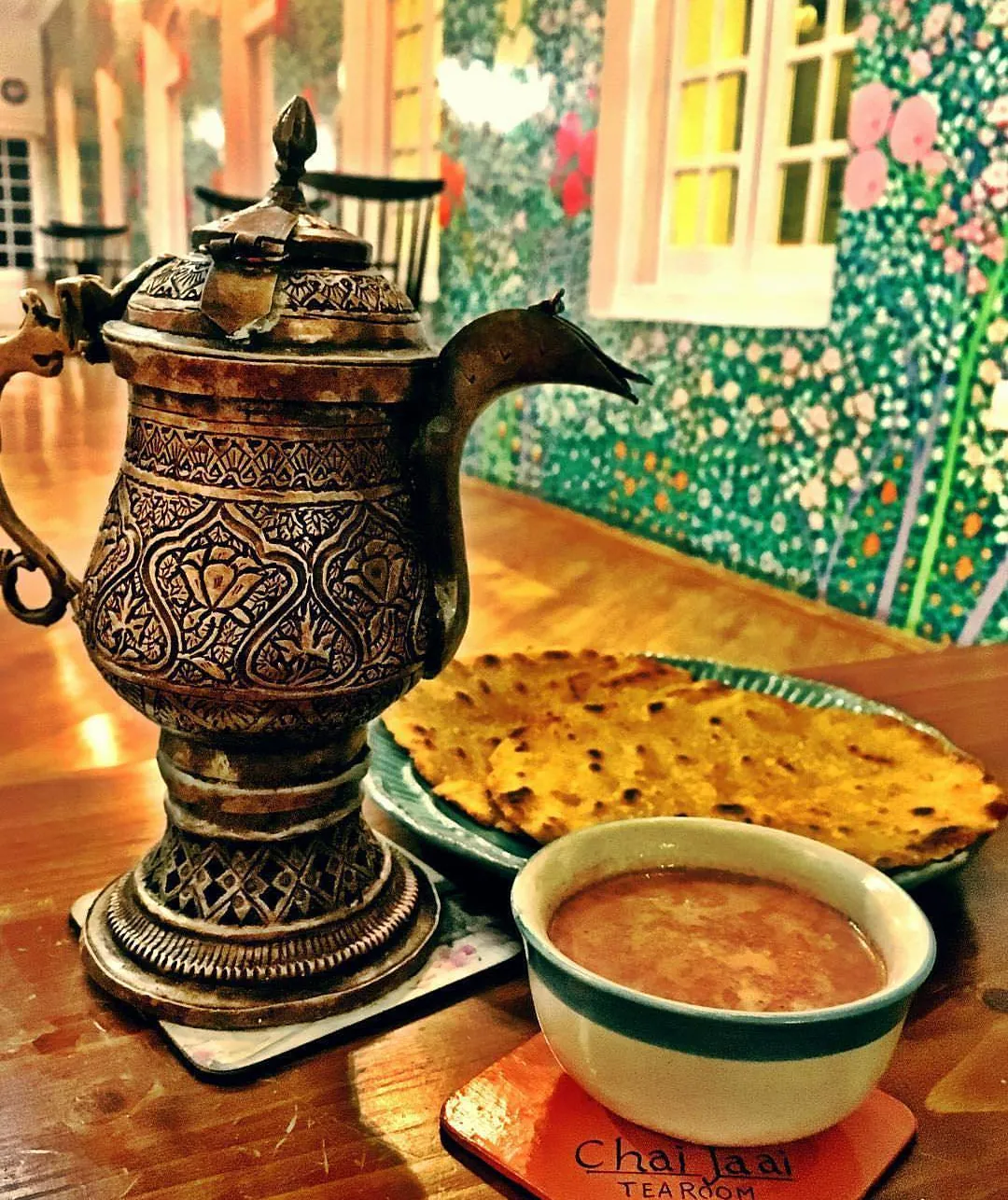
Doodh patti is the default in Punjab and much of Sindh, but it is far from the only tea in the country. Kashmiri chai, also called noon chai or pink tea, is made from green tea leaves boiled for a long time with a pinch of baking soda, then aerated and finished with milk until it turns a soft pink; in Kashmir it is traditionally salted, while in Pakistani cities it is more often sweetened and scattered with crushed pistachios and served at weddings and on winter evenings. Kahwah, a green tea brewed without milk and often with cardamom, is widely drunk after meals in Khyber Pakhtunkhwa and among Pashtun families elsewhere. In the high valleys of Gilgit-Baltistan, salted butter tea belongs to the same family of drinks found across the Himalaya. They are all called chai, and they are all offered the same way.
Frequently asked questions
What does doodh patti mean?
Doodh means milk and patti means leaf, so doodh patti is “milk leaf” tea: tea leaves boiled directly in milk, usually with sugar, rather than in water with milk added later.
Why is Kashmiri chai pink?
It is made from green tea leaves boiled for a long time with a small amount of baking soda, then aerated by ladling or pouring from a height. The alkaline brew turns a deep red, and adding milk softens it to pink.
What is the difference between chai and kahwah?
In Pakistan, chai usually means black tea cooked with milk and sugar. Kahwah is green tea brewed without milk, often with green cardamom, and is commonly drunk after meals in Khyber Pakhtunkhwa.